
Publish Date - August 30th, 2026
|Last Modified - August 30th, 2026
Quick summary: I’m excited to return to Product-Led Summit Toronto on November 12–13, 2026, after attending the conference in both 2023 and 2025. What keeps bringing me back is not simply the speaker lineup. It is the combination of practical product thinking, conversations with people facing similar problems, and the kind of in-person networking that can turn a two-day conference into relationships and ideas that last well beyond the event.
Returning to Product-Led Summit in 2026
This November, Product-Led Alliance is bringing Product-Led Summit back to Toronto at the Marriott Downtown at CF Toronto Eaton Centre. The conference runs November 12 and 13, with Product-Led Alliance currently expecting more than 400 attendees, 100+ companies, and an audience heavily weighted toward senior management.
https://world.productledalliance.com/location/toronto
I’ve attended the Toronto summit in both 2023 and 2025, so this will be my third time going. That history is a big part of why I’m looking forward to 2026.
There are plenty of conferences where you leave with pages of notes that never get opened again. The Product-Led Summit has been more useful to me because the strongest sessions tend to connect product theory with the decisions people are actually making inside large organizations.
One of the best part of these conferences, is being able to intermingle with different companies and corporations from all over Canada and the world.
That distinction matters for anyone planning a professional conference. Attendees are not really buying access to presentations. They are buying the possibility that something they hear, someone they meet, or a conversation they have changes what they do when they return to work.
The Sessions That Stay With You
One of the best examples from my previous experience was Sahil Lakdawala’s 2023 presentation, Metrics That Matter: Evaluating Product Success Through Data. At the time, Lakdawala was Director of Digital Product Management at Scotiabank.
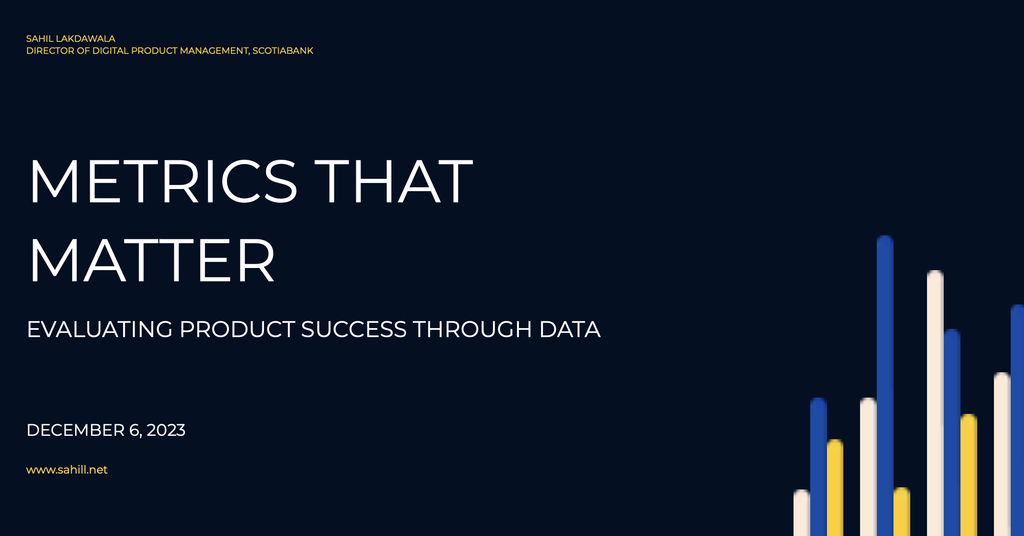
What made the session useful was that measurement was not treated as an exercise in building bigger dashboards. The presentation framed metrics as stories about what customers actually experience when they use a product and as a compass for making better product decisions.
It then became progressively more practical. The framework argued that the right metrics depend on the type and maturity of the product, the size of the organization, and its industry. It also distinguished between leading and lagging indicators and argued that both need to be considered together rather than optimizing exclusively for the final business outcome.
Later examples applied those ideas to signup, transaction, and login flows rather than leaving them as abstract principles.
That is the kind of conference content I remember three years later.
For an event planner, there is a lesson in that. Great conference programming moves the attendee from idea to example to application. If the content never gets past the idea stage, the audience may enjoy the presentation but struggle to remember why it mattered once the conference is over.
Why the 2026 Program Feels Timely
The 2026 summit arrives at an interesting moment for product teams. AI is altering how products are built, budgets are under greater scrutiny, and product leaders are increasingly expected to explain business outcomes rather than simply defend roadmaps.
Product-Led Alliance is clearly building this year’s Toronto event around those pressures. Current sessions include discussions about why product teams need to think like business owners, building personal AI operating systems, competing in an AI economy, and interactive roundtables with product leaders from companies including JPMorgan Chase, Adobe, Sezzle and others.
https://world.productledalliance.com/location/toronto/agenda
For me, the roundtable component is particularly interesting. The value of attending a conference in person drops considerably if the experience could have been replicated by watching eight presentations on YouTube.
The physical event becomes valuable when it creates conversations that would otherwise never happen.
The Conference Experience Is a Product Too
There is another reason I pay attention to events like Product-Led Summit, especially when thinking about them through the lens of ConferenceBadge.
A conference has its own customer journey.
Someone discovers the event, evaluates whether it is worth attending, registers, arrives at the venue, receives a badge, navigates sessions, meets other attendees, speaks with sponsors and then decides whether any of those relationships are worth continuing afterward.
The keynote may be the most visible part of that experience, but seemingly small operational decisions can influence whether the rest of the journey works.
Networking is a good example. Product-Led Alliance explicitly positions the Toronto summit as a place to connect with product leaders dealing with similar AI, organizational and stakeholder challenges. PCMA has similarly highlighted how major conferences are redesigning physical spaces to help large events create smaller communities where attendees can more easily find people with common interests.
The implication for planners is important: networking cannot simply be a 30-minute block labelled Networking on an agenda.
You have to reduce the friction between meeting someone and maintaining that relationship.
A Badge Can Be Part of the Networking Experience
That is also where badges are becoming more interesting.
A conference badge traditionally answers a simple question: Who is this person?
But a QR-enabled badge can also help answer the next question: How do we stay connected?
Event technology providers are increasingly moving in this direction. Cvent, for example, now supports attendee-to-attendee contact exchange through badge scanning, allowing participants to share information after meeting rather than relying entirely on business cards or manually searching for one another afterward.
For event organizers, exhibitors, associations and universities running their own conferences, that creates an opportunity to treat lead retrieval as part of the attendee experience rather than something reserved exclusively for the exhibition floor.
ConferenceBadge’s Lead Retrieval Generator for trade shows and conferences, follows that same idea. Organizers can create a lead retrieval experience that supports exhibitor lead capture, but it can also help attendees collect the connections they make during the event.
Done well, the technology should almost disappear into the interaction. Two people have a useful conversation, scan a badge, and continue talking. The connection is preserved without turning the interaction into an administrative task.
Done poorly, networking ends with a pocket full of business cards, forgotten names and LinkedIn searches several days later.
I’m looking forward to the sessions and seeing how product leaders are approaching AI, measurement, business outcomes and organizational change. But having attended in 2023 and 2025, I also know that some of the most valuable moments are likely to happen between those sessions.
The best conferences give people useful content. The better ones create the conditions for useful conversations.
And the best ones make it easy for those conversations to continue after everyone goes home.